
How Was Rock ’n’ Roll Born?
Before guitars were raised above roaring crowds and stadiums filled with fans, there were churches, clubs, radio stations, and musicians borrowing ideas from one another.
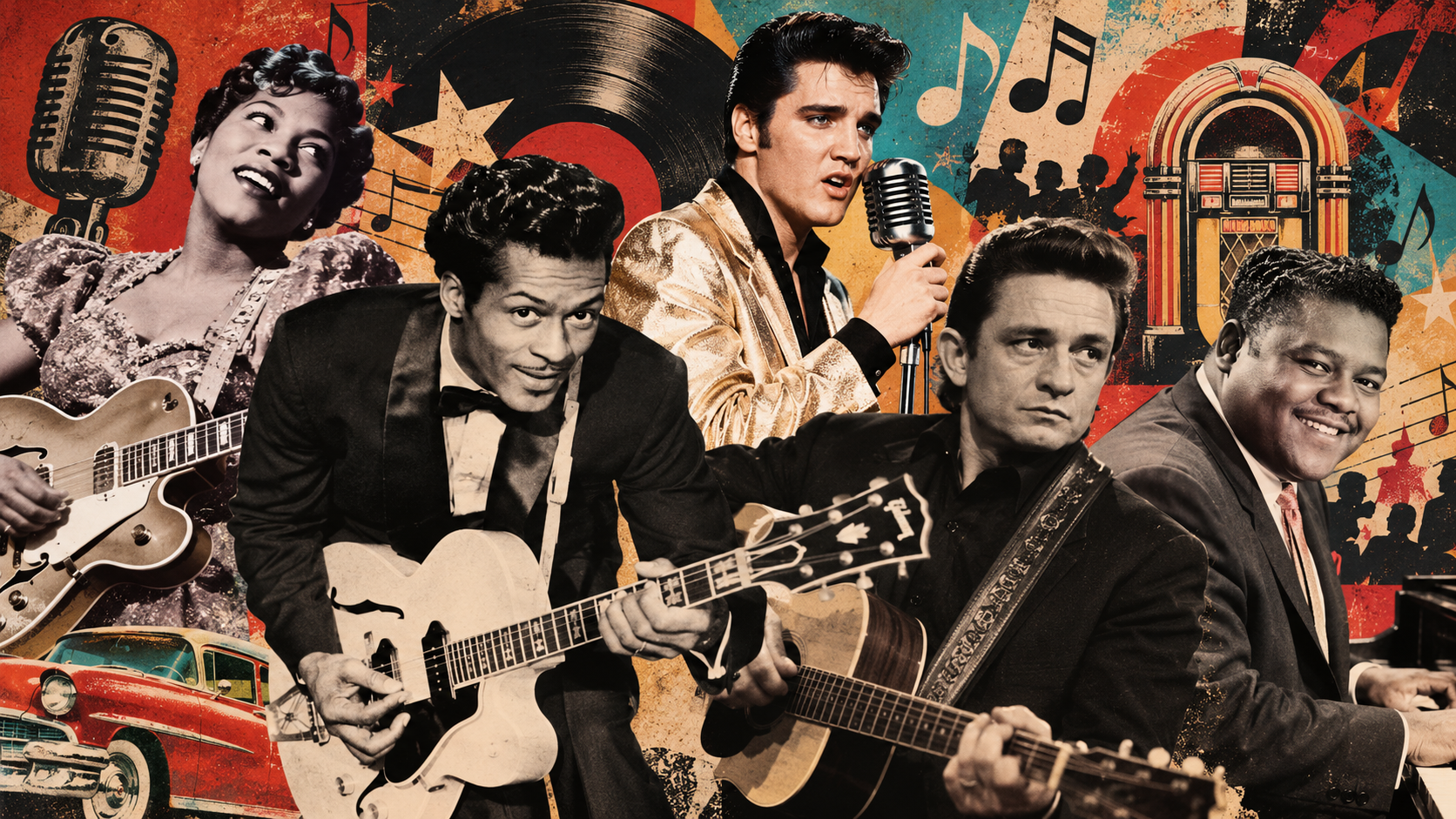
Before guitars were raised above roaring crowds and stadiums filled with fans, there were churches, clubs, radio stations, and musicians borrowing ideas from one another. In the 1940s, Sister Rosetta Tharpe was singing gospel while making her guitar roar. A few years later, Chuck Berry transformed that energy into riffs and stories about teenage life. Elvis Presley, in turn, brought a mixture of blues and country to millions of listeners.
Yet rock ’n’ roll was born neither from a single song nor in the hands of a single artist. Its history runs through American segregation, the rise of rhythm & blues, the growth of independent record labels, and the emergence of a new generation of young listeners. To understand how it conquered the world, we first need to hear what was being played before anyone gave it a name.
Before Rock: Segregated America
At the beginning of the 20th century, the United States was producing an extraordinary variety of music within a deeply unequal society. Segregationist laws and practices separated audiences, venues, and career opportunities. Record companies often marketed recordings by Black and white artists in separate categories. These barriers shaped how musicians were recorded, promoted, and paid. They could not, however, prevent musical styles from circulating.
The blues, developed within African American communities, gave future rock music a distinctive way of singing, call-and-response musical phrases, and a strong emphasis on personal expression. The guitar could accompany the voice, challenge it, or echo its final phrase. Piano, harmonica, and later the amplified guitar enriched this conversation. The twelve-bar structure associated with the blues can also be heard in countless rock songs, although neither blues nor rock can be reduced to that formula.
In Black churches, gospel cultivated another kind of intensity: powerful voices, hands clapping out the rhythm, and calls and responses between singers and congregations. The lyrics spoke of faith, but the physical and emotional commitment went far beyond simply performing a melody. Gospel gave rock a way of building tension and lifting an audience.
Rhythm & blues developed primarily in American cities during the 1940s. Drawing from blues, jazz, and swing, it emphasized danceable rhythms, horn sections, piano, and increasingly the electric guitar. Some ensembles became smaller, more direct, and more forceful. At the same time, boogie-woogie established its repetitive piano bass lines: a perfect engine for getting a room moving.
Country music contributed concise storytelling, accessible melodies, and fast instrumental playing. It had itself developed through contact with other traditions, despite the racial boundaries imposed by the music industry.
Musicians heard all of these forms around them. Rock emerged when their mixtures began attracting a new audience. Its history is also the story of African American artists who were rarely given the same opportunities for exposure as white stars.
Sister Rosetta Tharpe: Rock Before It Had a Name
Long before the heroes of the electric guitar, Sister Rosetta Tharpe stood at center stage with one in her hands. Born in Arkansas in 1915, she grew up in the Pentecostal church. Her mother sang and preached, and Rosetta learned to sing and play guitar at a very young age. In that religious tradition, music encouraged active participation from the congregation. There, she developed a voice capable of moving from tenderness to exclamation before turning a chorus into an event.
After moving to New York, Tharpe recorded for Decca and began performing outside strictly religious settings. In 1938, Rock Me already displayed a combination that unsettled some religious listeners of the time: gospel-rooted singing, showmanship, and a guitar demanding attention of its own. That same year, she performed at the Cotton Club. Performing sacred music in venues associated with secular entertainment was controversial, but it also allowed her to reach entirely new audiences.
Tharpe’s guitar playing deserves particular attention. She emphasized the rhythm with biting chords, fired off short phrases between vocal lines, and sometimes allowed the instrument to take the lead. Her playing evolved over the years along with the instruments she used; it would be misleading to project the heavily distorted rock sound of later decades onto her recordings from the 1930s. Even so, we can already hear an approach to electric guitar, riffs, and stage presence that would later become familiar features of rock.
Recorded in 1944, Strange Things Happening Every Day pushed the dialogue between gospel vocals, piano, and guitar even further. The song is frequently cited among the recordings that anticipated rock ’n’ roll. Calling it unquestionably “the very first” would be impossible: other musicians were developing similar sounds at the same time. Listening to it nevertheless reminds us how much of this story began before the commercial explosion of the 1950s.
Tharpe influenced and inspired performers from different generations. Sometimes the connection was direct, sometimes more diffuse: ways of singing, holding a guitar, or commanding an audience could spread through radio, records, and live performances. The Rock & Roll Hall of Fame describes her as a pioneering figure in rock guitar and inducted her in 2018 in the “Musical Influence” category. For decades, her role remained far less visible than those of her male successors. Source: Rock & Roll Hall of Fame
Sister Rosetta Tharpe did not single-handedly invent rock. But she makes it impossible to tell a credible story in which rock begins with Elvis Presley: long before him, a Black woman was already bringing together gospel, electric guitar, and explosive stage presence.
When Rhythm & Blues Became Rock ’n’ Roll
Between the late 1940s and the mid-1950s, several artists gradually brought R&B closer to the sound that mainstream audiences would come to call rock ’n’ roll. There was no precise musical boundary to cross: the same record could be classified as R&B when released and later be regarded retrospectively as rock.
Saxophonist and bandleader Louis Jordan knew how to create short, humorous songs designed for dancing. With his Tympany Five, he popularized an energetic sound in which swing was tightened around an infectious rhythm. His Saturday Night Fish Fry, released in 1949, is regularly mentioned when tracing the earliest roots of rock. Source: Rock & Roll Hall of Fame
Big Joe Turner came from blues and jazz. His powerful voice could effortlessly rise above the bands accompanying him. In 1954, Shake, Rattle and Roll demonstrated how effectively an R&B song could reach an audience ready to dance to a more direct rhythm. A cover by Bill Haley and His Comets would also bring the song considerable exposure among white listeners. Wynonie Harris, another exuberant singer, had already caused a sensation with Good Rockin’ Tonight in 1948, based on a song by Roy Brown. The titles, rhythms, and attitude clearly pointed toward what was coming next. Source: Rock & Roll Hall of Fame, Big Joe Turner
In New Orleans, Fats Domino turned boogie piano and R&B into an instantly recognizable sound. His first hit, The Fat Man, appeared in 1949; Ain’t That a Shame and Blueberry Hill later brought him to an enormous audience. His warm voice is a reminder that early rock was not built solely around shouting or guitars: piano, groove, and melody were equally central to its identity. Source: Rock & Roll Hall of Fame
Then came Rocket 88, recorded in 1951 by Ike Turner’s band and released under the name Jackie Brenston and His Delta Cats. Its bouncing rhythm, lyrics about a car, and rough guitar sound have made it one of the most famous candidates for the title of “first rock ’n’ roll record.” That label perhaps says more about our desire to assign rock a precise birthday than about the music itself: earlier recordings already contained many of the same ingredients. Rocket 88 remains a striking milestone without settling the debate.
The sound traveled through a new cultural infrastructure. Jukeboxes made records accessible in bars and restaurants. Radio stations broadcast R&B beyond the audiences the industry had initially targeted. Independent labels could record and distribute artists overlooked by the major companies. Teenagers emerged as a powerful consumer group. In this environment, the term rock ’n’ roll helped market and name a phenomenon that was already underway. The new label should not erase the musicians who shaped the music before it received its new name.
Chuck Berry Gives Rock Its Language
By the time Chuck Berry arrived at Chess Records, rock already had rhythms, voices, and hit records. Berry gave it an especially enduring combination: guitar at the forefront, songs structured like miniature stories, and a way of speaking directly to young people. Born in St. Louis, he drew from blues, rhythm & blues, and country to create a style recognizable within seconds. Source: Rock & Roll Hall of Fame
In 1955, he recorded Maybellene for Chess. The song reworked musical material from country music, often associated with Ida Red, into the story of a car chase driven by a nervous, propulsive rhythm. Berry did not merely place two styles next to each other: he made them coexist within a fast, energetic song powered by his guitar and storytelling instincts. The result crossed commercial boundaries that had often separated records marketed to Black and white audiences.
Then listen to his introductions. Just a few notes are enough to set everything in motion before the vocals even begin. His guitar phrases combine the energy of the blues with a sharp attack; they are simple enough to remember yet distinctive enough to become a signature. The guitar no longer merely accompanies the singer: it announces the song, responds to the lyrics, and makes other young people want to pick up an instrument. The image of the guitar hero begins to take a recognizable form.
The lyrics matter just as much as the riffs. Berry writes about cars, romance, school, records, parties, and the desire to live according to your own rules. In School Day, the hours spent in class seem endless before music finally takes over. Sweet Little Sixteen captures the excitement of teenage fans. His songs found a common language for young people living in a society still deeply divided by race and class. That apparent universality did not erase the obstacles Berry himself faced as a Black artist in 1950s America.
With Roll Over Beethoven in 1956, he dramatized the collision between established culture and the new records making teenagers dance. Johnny B. Goode, released in 1958, tells the imagined rise of a young guitarist. Its protagonist embodies one of rock’s favorite stories: someone from humble beginnings whose talent might transform his life. The song’s introduction would become one of the most recognizable guitar passages in the genre.
On stage, Berry completed the picture with his duckwalk, a crouched step that made his guitar playing as visual as it was musical. For British musicians in the 1960s, he became a major reference point. The Beatles and the Rolling Stones covered his songs; Keith Richards studied his riffs closely. Berry did not create every element of rock, but he brought guitar, lyrics, and stage persona together into a model that generations of musicians would continue to develop.
Elvis Presley and the Popular Explosion
Elvis Presley grew up in the American South surrounded by musical traditions that existed alongside one another despite social divisions: country, gospel, blues, R&B, and popular music. His love of gospel remained present throughout his career. When he walked into Sun Records in Memphis, producer Sam Phillips was searching for sounds that escaped the music industry’s conventional categories.
In 1954, Elvis recorded an energetic version of That’s All Right, a song by bluesman Arthur “Big Boy” Crudup, with guitarist Scotty Moore and bassist Bill Black. The record was released by Sun. It featured a voice playing with the accents of both blues and country, a fluid guitar, and a strongly rhythmic upright bass. Elvis’s early recordings demonstrate how rockabilly emerged from these encounters: fast, stripped-down music that was difficult to fit neatly into any single category.
Elvis’s career reached another level after he moved to RCA. Beginning in 1956, Heartbreak Hotel, television appearances, and movies dramatically expanded his audience. His hairstyle, clothing, and movements on stage provoked both fascination and outrage. Rock became not only a sound but an image that mass media could carry directly into living rooms across the country. The Rock & Roll Hall of Fame emphasizes the way Presley brought music deeply shaped by Black traditions to an enormous white audience. Source: Rock & Roll Hall of Fame
That fame requires a precise account. Elvis did not invent rock ’n’ roll. Nor did he simply reproduce the artists he admired: his voice, interpretation, and the work of his musicians created something distinctive. But promotion, television, and segregation gave him opportunities for visibility that many Black pioneers did not receive. The success of his covers and his public image therefore raises important questions about credit, rights, and the distribution of rewards.
The story is richer when both dimensions are preserved. We can recognize Elvis’s talent and his contribution to rock’s worldwide expansion while also listening to the artists who came before him: Arthur Crudup, Big Mama Thornton, Sister Rosetta Tharpe, Fats Domino, and many others. Their records belong at the heart of this history, not merely in its prologue.
Johnny Cash: A Parallel Branch
Around the same time, Johnny Cash also arrived at Sun Records. He had grown up in Arkansas singing and listening to religious hymns, country music, and the popular sounds that traveled throughout the South. Gospel remained a profound part of his musical world. His deep voice, storytelling, and the stripped-down rhythm of his early recordings offered another expression of the energy transforming Memphis at the time.
With musicians Luther Perkins and Marshall Grant, Cash created the famous train-like rhythm associated with Folsom Prison Blues and I Walk the Line, both released in the mid-1950s. He shared the Sun Records environment with Elvis Presley, Carl Perkins, and, a little later, Jerry Lee Lewis. Their careers and styles intersected even as each musician moved in a different direction.
Cash is sometimes associated with rockabilly, particularly because of the rhythmic momentum of his early records. Yet his country roots, storytelling instincts, and gospel recordings continued to define much of his work. His admiration for major gospel voices, among whom Sister Rosetta Tharpe is often mentioned, belonged to this wider musical environment; it is better not to turn that connection into a claim of direct influence on every song without specific evidence. His induction into the Rock & Roll Hall of Fame in 1992 reflects the place his music occupies within this broader history. Source: Rock & Roll Hall of Fame
Cash demonstrates why the early history of rock cannot be reduced to a simple chain of successors. In Memphis, country, gospel, blues, and rockabilly shared musicians, studios, and an audience undergoing rapid transformation. His career follows a branch parallel to Chuck Berry’s, with its own songs and its own unmistakable voice.
The First Generation of Rock
A history focused only on Tharpe, Berry, and Elvis would still miss an essential part of the explosion of the 1950s. Little Richard brought an almost uncontrollable intensity to the piano. With Tutti Frutti, released in 1955, his voice, screams, and flamboyant presence opened up another vision of what a rock star could be. His style also reminds us how much rock inherited from the fervor of gospel. Source: Rock & Roll Hall of Fame
Bo Diddley built an entire sonic world around a rhythmic pattern that would eventually bear his name. Where Berry might tell a story, Diddley could captivate through repetition, percussion, and the relentless insistence of his guitar. The “Bo Diddley beat” would reappear in countless forms long after the 1950s. Source: Rock & Roll Hall of Fame
On the rockabilly and pop side, Buddy Holly helped establish the model of the singer who writes songs and performs them within a guitar band. Carl Perkins made his mark with Blue Suede Shoes; Jerry Lee Lewis turned the piano into a spectacular stage instrument with Great Balls of Fire. Gene Vincent, with Be-Bop-a-Lula, and Eddie Cochran, with Summertime Blues, revealed other faces of rock: rebellious style, restless guitars, and teenage frustrations transformed into songs.
This is not a ranking of the “true” founders. Each artist contributed something others would take further: a rhythm, a riff, an attitude, a way of writing, or a way of performing. Early rock was already diverse. Its reputation as guitar music should not make us forget the piano of Fats Domino and Little Richard, nor the horn sections of the rhythm & blues that preceded it.
How Rock Conquered the World
After the Second World War, part of the younger generation had more leisure time and disposable income. 45 rpm singles, radio, jukeboxes, and movies featuring the new stars carried rock ’n’ roll across the Atlantic.
In the United Kingdom, young musicians discovered American blues, R&B, and the first major rock hits. They learned the songs by ear and formed bands of their own. Records circulated through specialist shops, while touring American performers offered another way to experience the music firsthand.
The Beatles covered artists including Chuck Berry and Little Richard before developing an increasingly distinctive songwriting style of their own. Their success helped guitar-based bands reach an international audience. The Rolling Stones, meanwhile, openly displayed their attachment to African American blues and rhythm & blues and covered Berry from the beginning of their career. These interpretations introduced some songs to new audiences while raising a question that would persist: how many fans knew the artists who had created the original music? [Sources: Rock & Roll Hall of Fame, Beatles and Rolling Stones]
The British Invasion of the 1960s changed the scale of the phenomenon. British bands achieved enormous success in the United States, the very country from which so many of their musical influences had come. Musical circulation had become a two-way journey. Other European scenes — and soon bands across multiple continents — adopted these sounds, sang them in their own languages, and blended them with their own musical traditions.
Meanwhile, the music itself continued to change. Bands wrote more of their own material, experimented in the studio, extended song structures, and placed increasing importance on the album. The word rock eventually came to encompass forms far broader than the rock ’n’ roll of the 1950s. Beneath the new layers of sound, traces of gospel, blues, R&B, and country could still be heard. The road toward hard rock, punk, and metal began here as well.
Conclusion: A Collective History
Searching for “the inventor of rock” produces an appealing answer, but it makes the story smaller. Sister Rosetta Tharpe had already turned gospel vocals and electric guitar into a striking spectacle. Louis Jordan, Big Joe Turner, Wynonie Harris, and Fats Domino had made rhythm & blues danceable, popular, and increasingly close to what would soon be called rock ’n’ roll. Chuck Berry gave the guitar, teenage storytelling, and stage presence a form that other musicians immediately understood and adopted. Elvis Presley carried these sounds to an enormous audience, supported by an industry shaped by the inequalities of its time.
Then the Beatles, the Rolling Stones, and other groups carried that music back toward America and far beyond it. Rock became global because it continued to change hands, voices, and meanings.
Listening to its beginnings today means hearing that circulation — and restoring the place of the artists who created the sound before the whole world learned its name.